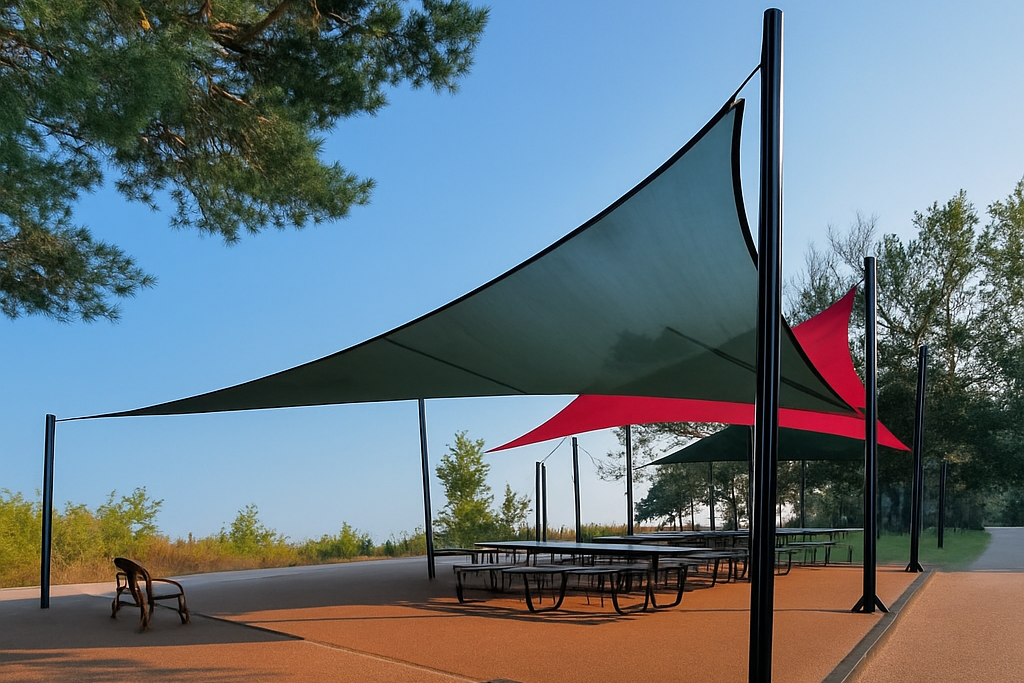
Sustainability has become a driving force in how we design and use our living spaces. From residential backyards to large community projects, the demand for solutions that balance comfort, style, and environmental responsibility has never been higher. Shade sails, while often chosen for their striking design, also deliver meaningful sustainability benefits that make them a smarter choice for the future.
One of the most immediate environmental benefits of shade sails is their ability to reduce heat. By blocking direct sunlight, sails can lower ground, patio, and playground temperatures by several degrees. This cooling effect makes outdoor spaces more comfortable in Ontario’s hot summers and helps protect surfaces like decks, turf, and rubber playground flooring from heat damage. The cooling extends beyond the sail itself. Shaded outdoor areas reduce heat transfer into adjacent buildings, cutting the demand for air conditioning. For homeowners, that can mean lower hydro bills in peak summer months. For schools, restaurants, and municipalities, it translates into long-term energy savings and reduced carbon emissions.
Durability is another key sustainability advantage. Not all shade fabrics are created equal, but premium options like Monotec 370 and Shadetec 320 are engineered for long-term performance. This high-strength fabric resists UV degradation, tearing, and weathering, meaning sails last 10–15 years with proper care. Longer lifespans mean fewer replacements, less fabric waste, and a reduced environmental impact compared to less durable alternatives. In contrast to heavy construction materials like wood, steel, or concrete, shade sails require far fewer resources to manufacture and transport. Their lightweight design reduces emissions during production and delivery, and the minimal structural requirements further cut down the environmental footprint of each installation.
Sustainability is not only about durability, it is also about adaptability. Shade sails can be reconfigured, relocated, or removed entirely to suit changing needs. Unlike permanent structures that require demolition and create waste, sails can adapt to different seasons, site uses, or even new properties. This flexibility makes them a future-proof solution for growing communities and evolving outdoor spaces.
Another overlooked environmental benefit of shade sails is how they change behaviour. By making outdoor spaces more usable, they encourage people to spend more time outside rather than indoors relying on heating, cooling, and artificial lighting. Families gather in shaded backyards, children play longer in playgrounds, and restaurants extend patio seasons. Each of these shifts reduces reliance on resource-heavy indoor spaces and supports healthier lifestyles.
As cities and homeowners in Ontario look to balance design, comfort, and environmental responsibility, shade sails stand out as a solution that delivers on all fronts. They provide cooling, reduce energy consumption, minimize waste, and create adaptable outdoor spaces, all while enhancing the look and feel of the environment around them. By choosing shade sails, you are not just adding shade, you are making a choice that supports a more sustainable future.
Ready to bring sustainable design into your own outdoor space? At Shade Sails Ontario, we create shade solutions that balance comfort, style, and environmental responsibility. Contact us today to learn more.